
Lahore, Pakistan, has been a major urban center on the Indian subcontinent for many centuries, and scholarship commonly associates the emergence of its historic core with early medieval settlement and later imperial consolidation (Shahzad, 2002). Its strategic position along regional trade and movement corridors encouraged commercial exchange, craft production, and religious travel, while repeated shifts in political authority shaped both social composition and built form. Over time, these processes produced an urban landscape in which architectural traditions and community practices were continuously reinterpreted rather than simply preserved.
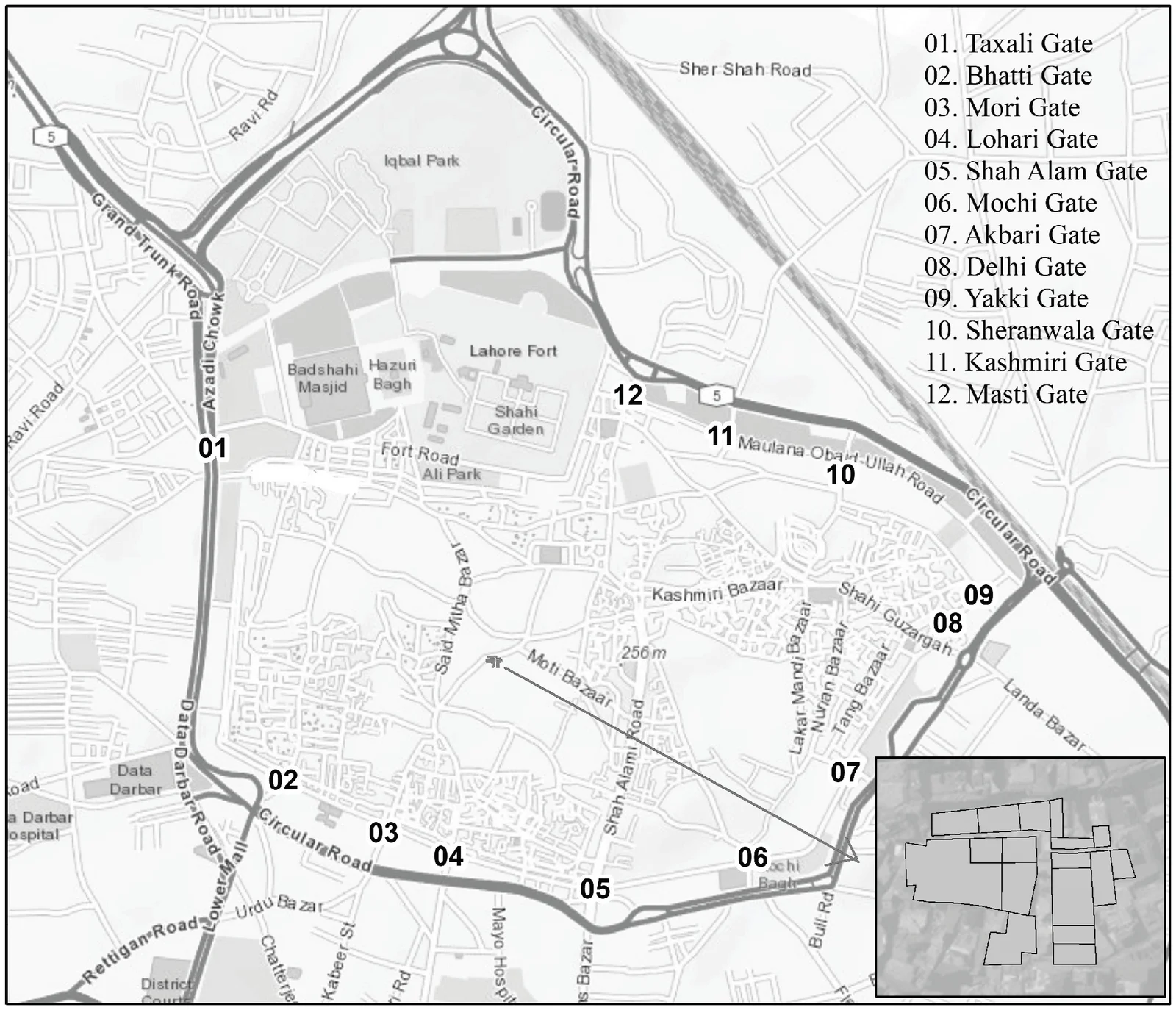
The Walled City of Lahore (WCL) remains a particularly concentrated expression of this legacy. Its morphology shows strong parallels with other historic Islamic cities: an enclosed perimeter, fine-grained and irregular lanes, a fort, bazaars, religious institutions, courtyard-based houses, and shared community spaces that mediate between public life and domestic privacy (Gulzar, 2017; Shahzad, 2002). Such environments are not static; they depend on continuous maintenance and locally embedded rules of use. When those rules and practices weaken, fabric change often appears as a set of cumulative small acts—additions, substitutions, and service installations—that gradually reshape both material character and environmental performance.
Two historical ruptures are particularly relevant to contemporary pressures in the WCL. Colonial rule after 1849 introduced new administrative and infrastructural interventions and new building typologies, alongside an architectural vocabulary that hybridized local traditions with European elements (Rahmaan, 2017; Ovais, 2016). Partition in 1947 produced a further and unusually abrupt demographic reordering: Sikh and Hindu populations relocated, Muslim migrants moved into vacated properties, and, over time, many earlier residents shifted to other parts of Lahore (Kaur, 2006; Qadeer, 1983; Adeeb, 2018). In such contexts, transformations in the historic urban fabric are not only technical outcomes of building repair; they are also social and institutional outcomes shaped by household needs, market forces, and the reach of regulation (Shahzad, 2011).
This paper addresses these intertwined pressures through a focused case study of Kucha Vahrian in the WCL. The study contributes (i) a literature-informed set of ten operational conservation parameters tailored to the types of alteration observed in Lahore’s historic neighborhoods, (ii) a structured documentation of post-partition transformations across 16 built units, and (iii) a triangulated interpretation combining physical survey evidence with resident accounts and an institutional reading of the governance framework. The objective is not to claim citywide statistical representativeness, but to provide a rigorous, repeatable diagnostic approach and a grounded explanation of why conservation pressures persist in a living historic neighborhood.
Comparative cases highlight how living historic cores are commonly exposed to two interrelated pressures: (i) deterioration and replacement driven by changing economic conditions, demographic shifts, and the expansion of contemporary services, and (ii) governance constraints that limit enforcement and everyday maintenance support. In Cairo, vernacular residential elements remain emblematic of local identity yet face displacement by concrete redevelopment. In Nicosia, rapid urbanization and political instability contributed to housing deterioration and environmental decline, prompting later strategic interventions that sought to reposition the historic core as a social and economic resource (Petropoulou, 2007). These cases illustrate that physical decline is rarely separable from institutional capacity and the incentives shaping urban change.
A second strand of international practice demonstrates the importance of craft knowledge, minimal intervention, and regulation that is enforceable and publicly intelligible. The restoration of the Chowmahalla Palace Complex in Hyderabad relied extensively on traditional craftsmen and adaptive reuse strategies (Goad, 2005). Rehabilitation experiences in the Islamic Mediterranean emphasize structural consolidation and careful facade repair as means of retaining character while allowing continued use (Petruccioli, 2007). Kuzguncuk along the Bosphorus provides an example of long-term protection through public participation paired with strict government regulation that constrains new construction to preserve the historic skyline (Uzun, 2003). Across these examples, the recurring methodological requirement is a diagnostic logic that translates conservation principles into observable building-scale indicators.
Pakistan’s heritage context includes both archaeological sites and living historic towns, each presenting distinct conservation challenges. Historic towns such as Bhera demonstrate how vernacular buildings and craft traditions (notably woodcarving) represent cultural value embedded in everyday architecture (Bukhari, 2016; Aamir, 2018). Uch Sharif illustrates the role of integrated value assessment and material-structural analysis prior to intervention (Mumtaz, 2017). In contrast, adaptive reuse schemes such as Saidpur Village show how tourism-driven redevelopment can undermine fabric coherence when construction expertise and conservation principles are not aligned, producing incompatible materials, surface treatments, and scale (Khan, 2015; Mumtaz, 2017). In Peshawar’s Sethi Mohallah, replacement by austere concrete buildings has similarly weakened streetscape character, motivating conservation initiatives that identify non-historic construction as hazardous to heritage continuity (Heritage Foundation of Pakistan, 2012).
Within the WCL, the rehabilitation of Gali Surjan Singh demonstrates that neighborhood-scale improvement is feasible when discreet infrastructure integration, housing repair, and facade restoration are paired with public sensitization supported through a community-based organization (Salman, 2018). The broader lesson emerging from both Pakistani and international experience is that successful conservation requires more than episodic projects: it requires a diagnostic method that can be repeated across neighborhoods, coupled with operational guidance on compatible materials, workmanship, and service integration that residents and local labor can realistically apply. The present study develops such a diagnostic logic through ten parameters and applies it to a neighborhood-scale case study.
Collectively, these ten parameters establish a structured framework for diagnosing transformations within the historic urban fabric of the WCL and for relating physical change to conservation practice. The research methodology developed from these parameters is presented in the following section.
Empirical documentation focused on 16 built units (summarized in Figure~2). For consistent recording, a “unit” was treated as an individual building plot or subdivided building segment that functions as a distinct physical and occupancy entity within the neighborhood. The ten parameters defined above were operationalized through a structured observation sheet completed for each unit during repeated field visits in 2018–2019. For every unit, the observation sheet recorded visible indicators for each parameter (materials and finishes; facade elements; structural traces; nature of repairs/retrofitting; type and location of additions; openness of voids and airflow paths; condition of openings; service routing; threshold and plinth continuity; and forms of encroachment). Observations were supported by photographic documentation and field notes to enable cross-checking across visits and to minimize reliance on single-moment impressions.
In addition to the physical survey, the study examined governance and awareness conditions that mediate conservation practice. A close reading of the Walled City of Lahore Act (2012) was undertaken to identify clauses relevant to conservation scope, regulatory control, and enforcement authority (Provincial Assembly of the Punjab, 2012). These clauses were translated into structured interview prompts for officials of the Walled City of Lahore Authority (WCLA), focusing on institutional responsibilities, the practical reach of enforcement, and the nature of outreach activities. In parallel, semi-structured conversations with residents explored awareness of regulations, perceived constraints on conservation-compatible repair, and the everyday decision-making logics behind additions, retrofits, and service installations. Interpretation relied on triangulation: physical patterns recorded through the parameters were compared with resident accounts and with official interpretations of statutory scope to identify consistencies, gaps, and plausible causal mechanisms.
Implementation of the above methodology generated evidence regarding transformations in the historic urban fabric of Kucha Vahrian, which are discussed in the next section.
To evaluate the urban fabric of the case-study area, it is necessary to consider land-use modifications that emerged during the post-partition period. Figure~2 summarizes the types of transformation observed across the 16 units examined in Kucha Vahrian. Semi-structured conversations with elderly residents suggested that in 1947 the neighborhood exhibited a coherent built environment, land-use structure, and architectural character, with shared spaces supporting both environmental comfort and community life. In one zone, houses were arranged around a communal courtyard containing a well (khooh) for residents in what is now unit~13. This aligns with Adeeb (2018), who reports that neighborhoods of that period typically possessed local wells for drinking water. Field observations showed that the courtyard space formerly containing the well has been replaced by residential construction, indicating a shift from shared environmental infrastructure toward intensified private built area.
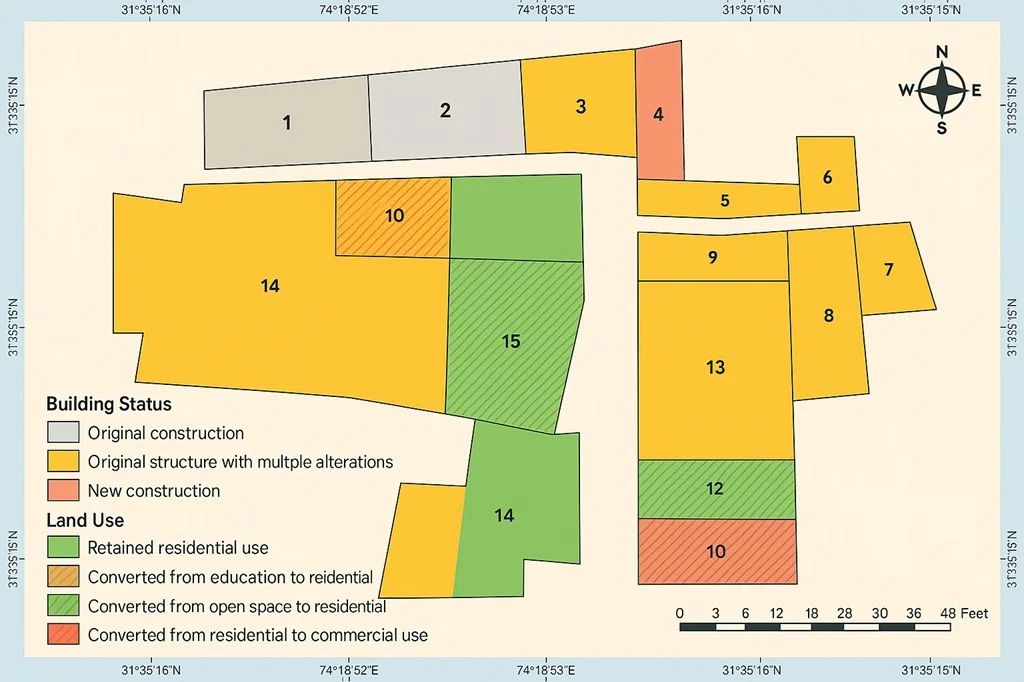
Similarly, a school building located at the edge of the neighborhood (units~15 and~16) ceased to operate as an educational facility in the post-partition era due to the influx of migrant families in need of urgent shelter. The school was converted into housing, and an adjacent open plot was used for new residential construction (unit~14). Moreover, the principal residence of the neighborhood (units~8–10) could previously be understood as a haveli—a large compound accommodating multiple (often related) families and sharing key spaces such as an entrance, central courtyard, and roof (Bryden, 2004). That building has since been subdivided into multiple units, thereby diminishing its former spatial hierarchy and reducing the legibility of compound-scale organization.
The current building stock can broadly be categorized into pre-partition and post-partition structures. The former includes historic houses with traditional facades, whereas the latter consists of non-historic buildings constructed on former open spaces or replacing older structures. The ten parameters defined in the literature review were applied to all 16 units (Figure~2) to document and interpret transformations in the neighborhood’s urban setting.
Site observations indicate that surviving traditional buildings still reflect vernacular construction identity through indigenous materials, customary facade detailing, legible structural traces, finely crafted doors and windows, and continuity with the original street plinth level (often visible through lowered thresholds relative to later resurfacing). These retained historic structures also illustrate vernacular environmental strategies, including openings, balconies, and spatial voids that facilitate daylight and airflow into interior spaces. In contrast, later non-historic structures appear visually plain and largely lack traditional characteristics in ornamentation, material selection, fenestration, structural approach, and threshold height. In addition, some older buildings no longer fully reflect their vernacular character and conflict with conservation ethics due to unsuitable retrofitting, unplanned spatial additions and encroachments, disorderly installation of service lines, and impediments to daylight and ventilation. These cumulative changes form the basis for the governance and practice interpretation presented in the following section.
The interview evidence indicates that the WCLA views the WCL as a valuable cultural asset that combines historical depth with architectural significance and can be enhanced as a tourism destination. Although heritage protection is often characterized as a weakly internalized social value in Pakistan (Mumtaz, 2017), residents of Kucha Vahrian nevertheless expressed attachment and pride in the area’s legacy. At the same time, many residents voiced discomfort about living in an economically marginalized neighborhood, suggesting a tension between cultural pride and social stigma that can encourage aspirations for “modern” building forms and finishes.
When interpreted through the ten-parameter diagnostic, the neighborhood’s most persistent pressures are cumulative processes rather than isolated defects. Residents respond to shifting household needs by constructing plain additions, enclosing spatial voids, and installing utility lines onto already stressed building fabric. Where additions overload older structural systems, where openings are blocked or balconies enclosed, and where shared/open spaces are built over, the result is both loss of heritage legibility and measurable decline in environmental quality, particularly through reduced access to daylight and ventilation. These transformations also demonstrate a departure from indigenous materials and craft techniques, which further weakens the coherence of the historic streetscape.
In an attempt to control these trends, the WCLA issued building regulations intended to limit additions and encroachments (Government of the Punjab, 2017). However, triangulation of official interpretations and resident accounts suggests that regulations and local practice remain weakly connected. Residents reported limited awareness of the existence and content of regulations, and they described little access to practical, neighborhood-level guidance on how to repair, extend, or service buildings without harming heritage character. When questioned about awareness-building activities, WCLA officials pointed to workshops and seminars conducted in high-end hotels, which were reportedly attended mainly by professionals and students. Residents, in contrast, reported no knowledge of such initiatives and implied that these events did not address their realities. This disconnect contributes to limited training and weak awareness among residents regarding how to intervene in historic structures without undermining fabric integrity.
A conservation pilot in another locality within the WCL, namely Gali Surjan Singh, provides a constructive model showing that heritage training and public sensitization, supported through a community-based organization (CBO), can enable successful outcomes (Salman, et al., 2018). Nevertheless, the project did not translate into broader impact across the WCL, largely because there was no permanent local institution to coordinate and sustain similar efforts at scale. This limitation parallels the experience of the Orangi Pilot Project in Karachi, which cultivated long-term public trust partly because it maintained a continuous local presence (Mumtaz, 2017). The comparative lesson is that awareness, guidance, and monitoring are process requirements rather than one-off deliverables.
Most surveyed residents identified themselves as belonging to low-income groups and used financial constraints to justify why repair and construction work is rarely carried out in accordance with conservation-oriented architectural principles. Yet, external support from the World Bank and the Punjab government enabled the Gali Surjan Singh initiative to achieve strong architectural outcomes alongside high resident satisfaction (Salman, et al., 2018). WCLA officials, however, maintained that such funding was allocated only for that specific pilot and was not available for conservation interventions across the entire WCL. This indicates that, in the absence of scalable technical support and affordable guidance, cost-constrained households will continue to adopt short-term solutions that cumulatively erode heritage integrity.
After concluding that Kucha Vahrian has been unable to protect its historical urban fabric under current conditions, the authors conveyed this concern to WCLA officials and inquired about strategic planning for the wider WCL. Officials reported that a master conservation redevelopment plan had been produced. From the authors’ assessment, however, this document does not provide an implementable conservation strategy with operational guidance, monitoring mechanisms, and neighborhood-level processes, and instead functions primarily as a current land-use plan. This suggests that, at the macro scale, the WCL reflects an enlarged version of the same pressures and outcomes observed in the case-study neighborhood. On this basis, the authors developed a set of recommendations intended to support restoration and long-term conservation within Kucha Vahrian and, by extension, across the WCL. These recommendations are presented in the next section.
A first requirement is to strengthen and redirect the research and development functions of the WCLA toward operational conservation support. This involves documenting materials currently available in the market and assessing their suitability for heritage applications, developing feasible heritage-compatible materials and techniques, and translating these into practical guidance that residents and local labor can apply. It also requires identifying accessible channels for community counseling and defining strategies for mobilizing them, conducting a critical assessment of the WCLA’s technical capacity and specifying improvements, and producing prototype cases that explicitly demonstrate low-cost, heritage-compatible repair and service integration options.
A second requirement is to move beyond a project-by-project approach to expertise by establishing a permanent technical team within the WCLA. Such a team should include town planners, architects, conservation specialists, curators, construction managers, anthropologists, and archaeologists, rather than relying on temporary engagement of professionals for individual projects (Mumtaz, 2017). In addition, the team should operate under clearly defined terms of reference and standard operating procedures, supported by scheduled monitoring and follow-up mechanisms to ensure continuity and accountability (Feilden, 2003). Embedding the ten-parameter diagnostic within routine monitoring would allow emerging risks (for example, unchecked encroachment or dangerous retrofitting) to be identified early and addressed before irreversible damage occurs.
A third requirement is to develop practical trust and sustained working relationships between the WCLA and the local community. This includes identifying active community members who can form community-based organizations, following the participatory model adopted in the Gali Surjan Singh initiative (Salman, et al., 2018). It also includes facilitating group discussions among residents, conducting a strengths–weaknesses–opportunities–threats (SWOT) analysis (Feilden, 2003), and preparing proposals that are explicitly inclusive of community priorities and participation (Khan, 2015). Where residents perceive conservation as aligned with their everyday needs—comfort, safety, and affordability—compliance and collaboration are more likely to be sustained.
A fourth requirement is to counsel and sensitize the community through multiple communication channels. Religious scholars and clerics can be engaged to foster respect for the area’s multi-religious heritage and to support ethical guidance connected to civic responsibility. Heritage education should also be embedded within school curricula, including the introduction of heritage topics at the elementary level and the facilitation of workshops and informational sessions led by teachers (Qureshi, 1994). Awareness can further be expanded through print and electronic media, as well as through planning and promotion of heritage festivals, while CBO activities should be coordinated and supported to maintain continuity.
A final requirement is to implement community training programs that target both the labor force and residents. Local craftsmen and laborers should receive training in traditional and indigenous materials, compatible modern alternatives, facade repair practices, and building crafts (Qureshi, 1994). In parallel, residents should be trained on statutory provisions relevant to historic areas, common apprehensions regarding building by-laws, and the negative consequences of encroachments, inappropriate spatial additions, incompatible retrofitting, and alterations to established plinth levels. Together, these measures would shift conservation from an episodic project model toward a sustained neighborhood process.
The governance reading and interviews reveal that the WCLA recognizes the heritage value of the WCL and its potential for cultural tourism, yet a major gap persists between statutory intent and local practice. Residents are largely unaware of existing regulations, while current outreach efforts do not effectively reach the community most responsible for day-to-day building decisions. Moreover, regulations provide limited practical guidance on traditional materials and appropriate techniques, and conservation progress remains dependent on isolated, donor-supported projects rather than a continuous citywide process.
Overall, the findings suggest that conserving the WCL requires a shift from short-term, project-based interventions to a long-term, integrated approach that builds permanent technical capacity within the WCLA, establishes sustained community-based structures, delivers locally accessible training for residents and craftsmen, and provides clear, actionable guidance for heritage-compatible repair, services integration, and control of encroachments. While the case-study design limits statistical generalization, the ten-parameter diagnostic offers a repeatable framework that can support transparent monitoring and targeted intervention across other neighborhoods of the WCL.